PICO-SCALE OPEN FLUME PROPELLER WATER TURBINE PERFORMANCE UNDER VARIATION IN AIRFOIL THICKNESS-TO-CHORD RATIO
DOI:
https://doi.org/10.51630/ijes.v7i2.223Keywords:
Thickness, Chord, Propeller, Open Flume, Pico hydro turbineAbstract
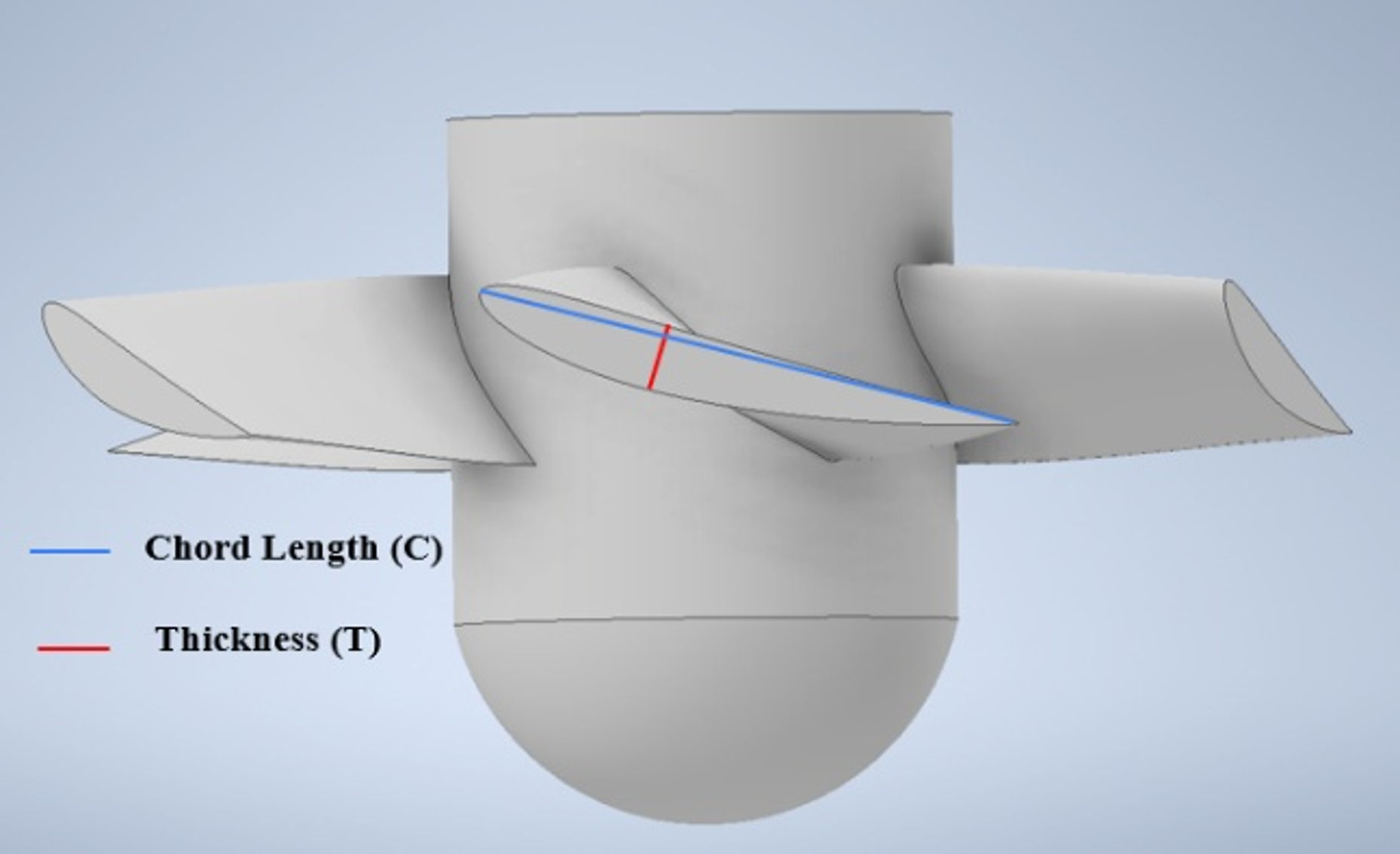
Air pollution from coal-fired power plants contributes approximately 44% of Indonesia’s CO₂ emissions. Transitioning to renewable sources, such as hydroelectric power, offers a viable solution, particularly with open-flume propeller turbines in remote areas. This study investigates the effect of T/C ratios on pico-scale open-flume propeller turbines using NACA 44XX airfoils. Three configurations (0.11, 0.12, and 0.13) with varying rotational speeds were evaluated using computational fluid dynamics (CFD) simulations with mesh motion in ANSYS Fluent, along with analytical methods for torque, power output, and efficiency. T/C 0.13 consistently delivered the best performance, reaching a maximum efficiency of 15.39% at 850 rpm. In contrast, the analytical method found that the maximum efficiency of that configuration is approximately 26% at 1100 RPM. The deviation between the analytical and numerical results arises from the analytical method's limitations in capturing the viscous shear flow around the turbine blades and the gap-clearance loss. The pressure distribution analysis revealed that T/C 0.13 maintained the most balanced high–low pressure zones, minimizing early flow separation. T/C 0.12 exhibited instability at high RPM due to less stable pressure differentials, whereas T/C 0.11 maintained stability with sharper pressure gradients and a higher risk of separation despite lower output. These findings emphasize the role of optimal blade geometry in improving efficiency, pressure–velocity stability, and flow control in small-scale water turbines. However, the lack of experimental testing in this study limits the validity of its results; further experimentation is needed.
Downloads
References
National Energy Council, Indonesia Energy Outlook 2024. Jakarta: National Energy Council, 2024.
R. Sipayung, “Peningkatan polusi udara di Indonesia: Perspektif ekonomi berdasarkan teori freakonomics,” Sekretariat Kabinet Republik Indonesia, 2023.
M. Bakırcı, R. Polat, and M. T. Özdemir, “Aerodynamic analysis of NACA 4412 airfoil with CFD for small scale wind turbine design,” J. Green Technol. Environ., vol. 1, no. 2, pp. 28–40, 2023.
Ember Energy, “G20 Per Capita Coal Power Emissions 2023.” Available: https://ember-energy.org/latest-insights/g20-per-capita-coal-power-emissions-2023/.
Humas EBTKE, “RUPTL 2021-2030 Diterbitkan, Porsi EBT Diperbesar,” Direktorat Jenderal Energi Baru, Terbarukan dan Konservasi Energi, Kementerian Energi dan Sumber Daya Mineral. Accessed: Dec. 11, 2023. [Online]. Available: https://ebtke.esdm.go.id/post/2021/10/06/2981/ruptl.2021-2030.diterbitkan.porsi.ebt.diperbesar
D. Zhou and Z. D. Deng, “Ultra-low-head hydroelectric technology: A review,” Renew. Sustain. Energy Rev., vol. 78, pp. 23–30, 2017.
R. Risnandar, F. A. Pratama, and N. Novrinaldi, “GIS untuk menentukan potensi pembangunan piko-hidro,” Jurnal Teknologi Informasi, vol. 1, no. 2, pp. 60–65, 2011.
Y. Wang, C. Jiang, and D. Liang, “Investigation of air-core vortex at hydraulic intakes,” J. Hydrodynamics, vol. 22, no. 1, pp. 673–678, 2010.
Warjito, Budiarso, K. Kameswara, S. B. S. Nasution, and M. F. Syahputra, “Effect of camber line variations on open flume turbine performance,” in AIP Conference Proceedings, AIP Publishing LLC, pp. 40008, 2021.
N. Sinaga, B. Yunianto, and Y. V. Pirie, “Effect of thickness-to-chord ratio and chord length on aerodynamics of GOE-387 airfoil,” Int. Res. J. Ind. Eng. Technol., vol. 08, no. 05, pp. 280–287, 2024, doi: 10.47001/irjiet/2024.805038.
Z. Markov, P. Popovski, A. Lipej, and V. Djelic, “On the influence of the Kaplan turbine runner blade thickness on its stress parameters,” in International Conference HYDRO, 2008. p. 111–114.
A. Semenova, D. Chirkov, A. Lyutov, S. Chemy, V. Skorospelov, and I. Pylev, “Multi-objective shape optimization of runner blade for Kaplan turbine,” in IOP Conference Series: Earth and Environmental Science, pp. 12025, 2014.
M. Banaszek and K. Tesch, “Rotor blade geometry optimization in Kaplan turbine,” TASK Quarterly, Scientific Bulletin of Academic Computer center in Gdansk, vol. 14, no. 3, pp. 209–225, 2010.
P. Chaitanya and G. S. Sharma, “Computational fluid dynamic analysis of Naca 0006 airfoil at different parameters with regression analysis,” Int. Res. J. Eng. Technol., pp. 1027–1034, 2022, [Online]. Available: www.irjet.net
P. Breeze, “Hydropower.” Academic Press, 2018.
M. Çolak and İ. Kaya, “Prioritization of renewable energy alternatives by using an integrated fuzzy MCDM model: A real case application for Turkey,” Renewable and Sustainable Energy Reviews, vol. 80, pp. 840–853, 2017, doi: https://doi.org/10.1016/j.rser.2017.05.194.
B. R. Munson, T. H. Okiishi, W. W. Huebsch, and A. P. Rothmayer, Fluid mechanics. Singapore: Wiley, 2013.
K. M. Almohammadi, D. B. Ingham, L. Ma, and M. T. T.-C. fluid dynamics (CFD) mesh independency techniques for a straight blade vertical axis wind turbine Pourkashan, “Computational fluid dynamics (CFD) mesh independency techniques for a straight blade vertical axis wind turbine,” Energy, no. C, pp. 58–483, 2013, doi: 10.1016/j.energy.2013.06.012.
M. Kaya, A. Kök, and H. Kurt, “Comparison of aerodynamic performances of various airfoils from different airfoil families using CFD,” Wind Struct. An Int. J., vol. 32, pp. 239–248, Mar. 2021, doi: 10.12989/was.2021.32.3.239.
Downloads
Published
Issue
Section
License
Copyright (c) 2026 Indonesian Journal of Engineering and Science

This work is licensed under a Creative Commons Attribution-NonCommercial-NoDerivatives 4.0 International License.